
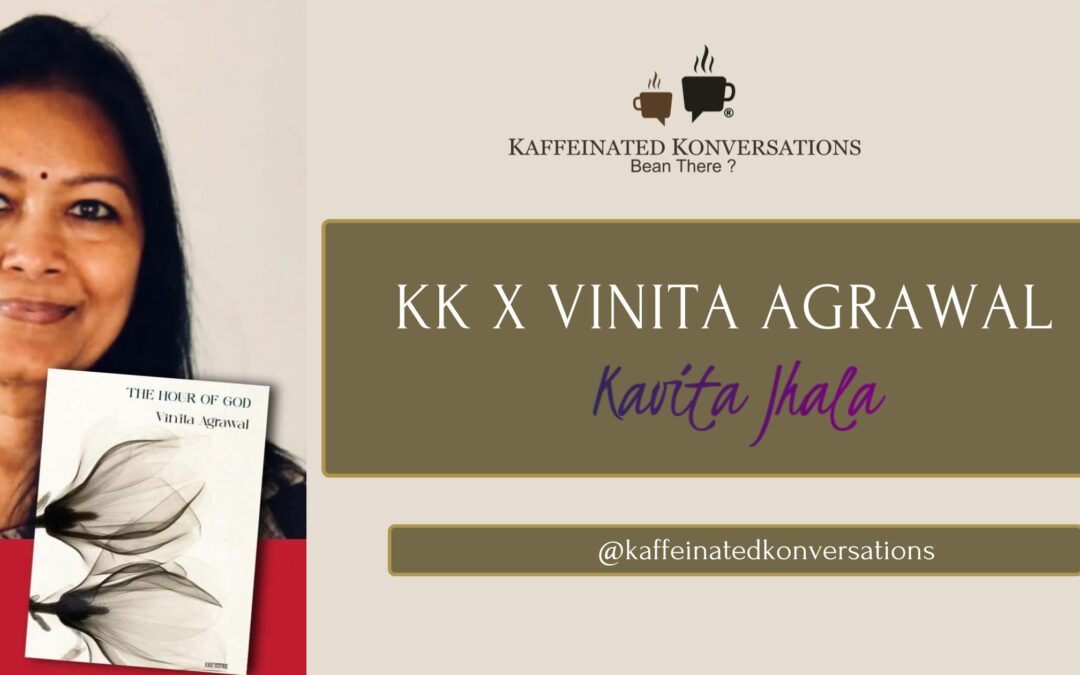
Founder of Kaffeinated Konversations, Kavita Jhala in conversation with Vinita Agrawal.
Vinita Agrawal is an acclaimed poet, editor, and author. This conversation is related to her book of poems – The Hour of God.
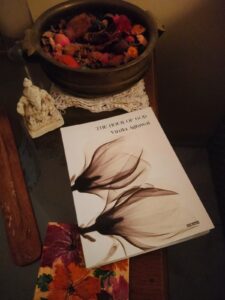
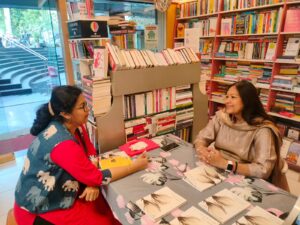
Kaffeinated Konversations had the pleasure of hosting a book session with her at Reader’s Paradise, and we also got to strike up a conversation and know each other better.
KK: In The Hour of God, you anchor your poems in the quiet, diffused space of Brahma Muhurta— “Hour of God.” What drew you to explore the sacredness of this gentler, dawn-lit hour of awakening, and how did it shape the rhythm of this collection?
VA: You’re right. In The Hour of God, the Brahma Muhurt or that specific time when everything is pure and sacred, has been used as the fulcrum for the poems. Because of the sacredness of that hour, deepest thoughts emerge in that space, and when we put them into words, there is a certain sanctity attached to those words.
KK: Your collection opens with an invocation to wholeness from the Brihadaranyaka Upanishad, yet the book frequently navigates fragmentation, personal loss, and ecological decay. How do you balance the spiritual truth of “wholeness” with the painful, fragmented realities of the modern world in your writing?
VA: That’s a great question. You know the Upanishadic quote says that everything is whole. It is always perfect. No matter how many fragments emerge from the whole, they are complete in themselves. This is a great message of hope and optimism, which the poems contain. The subject of the poems may be loss, grief, or environmental devastation, yet there is an underlying message of wholeness and a certain scope of betterment as things evolve.
KK: In pieces like “Conversation with a Seed”, you give a voice to things that are small, buried, and patient (“Listen—this dark is a patient craft”). What does writing from the perspective of seeds, flowers, trees, or birds tell you about the human process of enduring difficult, invisible transitions?
VA: I actually often write persona poems. I turn myself into a seed and write from its perspective. I’ll turn into a river and write from that angle or a tree or a mountain, as the case may be. This is a common practice amongst poets. Often we suffer and write about human anguish, but the truth is, it’s not only us, but all sentient beings also suffer. Every aspect of nature faces pain. For example, a seed endures great hardships. Once it’s planted in the soil, it’s not easy for it to break its husk, which is extremely hard, and then to find the right conditions for it to sprout is a tough challenge. We might not realise it, because we kind of separated the seeds’ difficulties from our own difficulties, but the fact is that everything in nature endures its own obstacles and transitions.
KK: In “Teach Me, Bulbul”, you write about blooming and breaking, asking to learn how to shed without a groan. In a world that often demands constant holding on, how has writing The Hour of God helped you personally understand the spiritual necessity of letting go?
VA: Actually, detachment, letting go, and surrender are a part of my inner beliefs. They are my personal values. So it’s not that this book has helped me enhance such spiritual practices; in fact, the opposite is true – my practices have led to this book.
KK: Across your writing work, including poems, “home” is rarely just architectural; it is organic, built in dew drops, moss, memory, and “in the centre of your palms.” As someone who has lived across different cities and is now based in Indore, how has your definition of “home” shifted over your seven books?
VA: Actually, detachment, letting go, and surrender are a part of my inner beliefs. They are my personal values. So it’s not that this book has helped me enhance such spiritual practices; in fact, the opposite is true – my practices have led to this book.
KK: Looking back at your earlier books, like The Silk Of Pure Flight and Words Not Spoken, you’ve noted that pain has a “penumbra of numbness” that eventually shifts us toward stillness. How has your relationship with translating grief into poetry evolved from your debut in 2013 to your work today?
VA: I’m surprised that you’ve been able to look into my books from 2013. Thank you for that. I have always written about grief. Now the language in which I express myself is better evolved. The craft is better. It is better because it’s been over a decade now, and as one continues to write, the craft of writing poetry improves. However, the core emotion of grief stays the same.
KK: Having edited powerful anthologies on climate change like Open Your Eyes, your work heavily critiques ecological commodification. Do you view the act of writing eco-poetry primarily as a form of quiet preservation, or as an active, urgent political resistance against “the grime of commerce”?
VA: Oh, 100%, it is an active, urgent call to sensitise people to these matters. These very extremely important issues of climate change. Global warming, pollution, tree destruction, devastation of the earth. It is not that kind of poetry of preservation, no, certainly not. It is a call to take action and make a difference to our planet.
KK: You write poetry, fiction, and non-fiction, and you recently received an award from the Science Fiction and Fantasy Poetry Association for “The Light Phenomena”. Are we seeing a shift into more speculative or fantastical eco-poetry, and can we expect a dedicated foray into prose or speculative writing next?
VA: I didn’t really write speculative poetry earlier, but these days I have the desire to write on those subjects. The Light Phenomena is an interesting poem on the moment when the sperm meets the ovum inside the womb. Miraculously, a light is produced at that moment. It is based on that phenomenon. Of course, not all my poetry will be speculative, but I do like to write about research-based subjects.
KK: As someone deeply embedded in the literary community—having convened the PEN All-India Centre and received the Jayanta Mahapatra National Award—how do you see the space of Indian English poetry evolving, especially with younger generations leaning heavily into digital spaces?
VA: I have great admiration for the way the younger generation is taking the mantle of poetry forward. They are very good at writing page poems as well as spoken poetry and poems for social media. I’m proud of our young generation who’ve expressed interest in poetry. They really do address all kinds of issues in their poems, which is great.
KK: In “Before the Ancestral Home”, you write the poignant line, “The new key is not mine.” If The Hour of God leaves us at a threshold of patience, observation, and waiting for renewal, where is your creative compass pointing you next? What is the next new project we can expect from you?
VA: Thank you for quoting that line. It’s one of my favourite lines from the book and that particular poem is a deeply, deeply personal one. I have a very special place for it in my heart. So regarding my future projects, yes, there is another book in the pipeline. A collection of poems, mostly existential poetry
—–
About Vinita Agrawal:
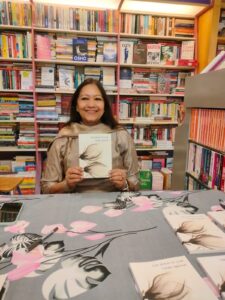
Based in Indore, India, Vinita Agrawal is an acclaimed poet, editor, and author holding an MA in political science and a diploma in Computer Applications. She has authored six poetry collections, including the award-winning Eartha, a children’s fiction book, and has edited four notable anthologies, while also co-editing the Yearbook series of Indian Poetry in English and serving on the Advisory Board of the Tagore Literary Prize. Her extensively published, anthologized, and translated work has earned her numerous prestigious honors, including the Jayanta Mahapatra National Award for Literature 2025, the Proverse Prize Hong Kong, and the Rabindranath Tagore Literary Prize, alongside being featured in the Taiwanese documentary Deepest Uprising. Outside of her literary achievements as a widely traveled festival reader and former editor, she is a passionate birder, photographer, and nature lover. More information can be found at www.vinitawords.com.